
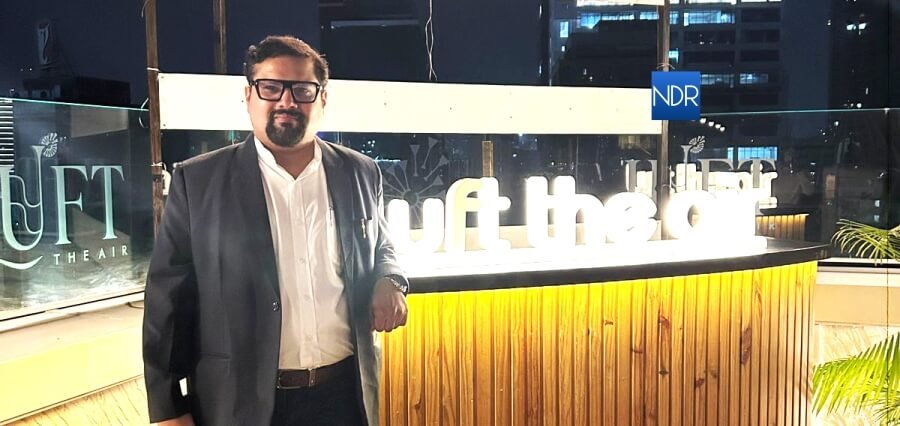
The fashion-driven hospitality industry, often characterized by rapid shifts in trends and consumer expectations, offered Aditya Vaidya the opportunity to build a distinctive career by focusing on questions others often overlook. What protects quality after the food leaves the kitchen? What prevents minor operational lapses from escalating into brand crises? What allows creativity to scale without collapsing under its own complexity? These questions did not merely shape his professional curiosity; they became guiding principles that influenced both his career trajectory and his broader philosophy toward operational excellence.
Having entered the hospitality industry in 2006 with a formal graduation in Hospitality Management, Aditya developed an early appreciation for the intricate systems that support successful food operations. While actively working in the industry, he further strengthened his academic foundation by completing his MBA through correspondence. His additional background in shipping and logistics reinforced his ability to view operations through a systems-driven lens. He began to see commercial kitchens not simply as creative spaces but as time-sensitive ecosystems where culinary expertise must work in harmony with operational precision, process discipline, and personnel accountability.
This systems-oriented perspective became the foundation of his work in delivery-first operations, food safety leadership, and advisory roles focused on structured organizational growth. Rather than chasing short-term industry trends, he concentrated on building resilient operational frameworks that integrate demand intelligence, compliance maturity, and logistics discipline into everyday business practices.
Throughout his career, he has supported brands in navigating unpredictable demand cycles, tightening regulatory environments, and evolving consumer expectations. His approach balances immediate operational realities with long-term preparedness. By empowering teams while maintaining clearly defined operational guardrails, Aditya believes organizations can achieve sustainable excellence. His leadership philosophy challenges conventional hospitality management models by emphasizing that consistent quality and scalable creativity are not accidents of talent but the result of carefully designed processes that are continuously protected and refined.
The Author Who Saw the Cloud Coming
Before cloud kitchens became a buzzword in every startup pitch deck, Aditya was already writing about them. His book, Cloud Kitchens: Rise in India with Global Cuisine, laid out a detailed framework for how delivery-first food businesses could not only survive but lead provided they approached the model with the rigor it demanded. Looking back from 2026, one prediction in particular has proven to be the most prescient: integrated demand intelligence.
“The convergence of real-time consumer data, predictive analytics, and procurement-led production planning has had the deepest impact on unit economics in modern hospitality,” he explains. The shift, as he describes it, fundamentally changed how kitchens think. Where decisions were once instinct-driven, chefs produced, sales followed, and waste was quietly absorbed as the most successful operators today allow data to discipline creativity. Kitchens have stopped being reactive. They are now predictive. Food waste has reduced. Manpower deployment has sharpened. Contribution margins have stabilized even through volatile demand cycles.
He believes technology did not replace the soul of cooking. It removed inefficiency from the process. The real winners, in his view, are not the operations with the most advanced tools, but those that embedded technology into everyday decision-making quietly, structurally, and without fanfare.
Systems That Set People Free
One of Aditya’s most frequently cited beliefs is that leadership is a function of structure rather than personality. In an industry that has historically celebrated the charismatic chef, the larger-than-life hotel general manager, and the magnetic restaurateur, this stance cuts against the grain. He is unapologetic about it.
“The guest experience feels personal because the system supporting it is invisible. When structures are weak, people are forced to compensate with personality — and that never scales,” he says. The reconciliation, as he frames it, is not a contradiction. Systems create reliability. And reliability, paradoxically, enables genuine human connection. A guest does not remember the SOP manual. But they remember timely service, consistent taste, hygiene, and emotional comfort, and those outcomes, he insists, are never accidental. They are designed.
This philosophy has direct roots in his academic background. His MBA in Shipping and Logistics from one of India’s business schools gave him an analytical lens that most hospitality professionals simply do not carry. Delivery-first hospitality, he argues. It is essentially a time-sensitive logistics business, one where food quality degrades with every minute and every handover.
“Logistics trains you to see friction points such as temperature variation, delayed dispatches, poor routing, and packaging mismatches. Most last-mile failures are not culinary failures. They are logistical blind spots,” he explains. By applying principles of cold chain integrity, route optimization, packaging engineering, and process redundancy to hospitality operations, he and his team at ATOLL Hospitality have helped brands protect quality well beyond the kitchen walls. Excellence, in his world, is not achieved at the stage. It is preserved until the doorstep.
Making Safety a Boardroom Conversation
Perhaps the most transformative aspect of Aditya’s career has been his sustained effort to reposition food safety from an operational afterthought to a strategic boardroom priority. As a certified Lead Auditor and food safety enthusiast, he has consistently argued that standards like ISO 22000 are not cost centers. There are more competitive advantages hiding in plain sight.
His message to CEOs who still view compliance as a checkbox exercise is direct: “Risk does not announce itself before it destroys value. Compliance is about control, predictability, and brand insurance.” Organizations that embed food safety into boardroom conversations, he has observed, scale faster, attract better investors, and recover more quickly from disruptions. Safety maturity, in his framing, reflects leadership maturity and the two rise together.
In 2026, with consumers more health-conscious and less forgiving than ever, the stakes have only risen. He and his team support brands in implementing real-time digital audits, traceability systems, live compliance dashboards, and automated deviation alerts, moving operations from reactive firefighting to proactive assurance. Today, transparency is not about telling your story. It is about allowing your processes to speak for themselves.
As a Lead Auditor who has walked the floors of expanding hospitality chains across the country, he has developed a sharp eye for a particular kind of invisible danger: process drift. “SOPs are documented, audits are passed, but behavior gradually shifts under operational pressure. What begins as a temporary workaround soon becomes normalized,” he explains. Standards erode silently. Guest trust declines before leadership even notices the erosion has begun. Brand damage, he observes, rarely happens overnight. It is almost always the accumulated weight of small, unchecked deviations.
Empowering Without Compromising the Non-Negotiables
Inside the pressure cooker of a busy commercial kitchen, decisions must be made in seconds. Aditya’s approach to middle management empowerment is built around a deceptively simple principle. His approach says that autonomy works only when non-negotiables are clearly defined and fiercely protected.
“We empower middle management with real-time decision authority on staffing, sequencing, and service recovery, but safety, hygiene, and critical controls are never flexible,” he says. When teams understand exactly where autonomy ends and standards begin, decision-making becomes confident, fast, and responsible. Structure, as he sees it, does not restrict freedom. It enables intelligent action.
This thinking extends to his broader view on talent development. The hospitality industry’s current challenge, in his assessment, is not a talent shortage; it is a discipline gap. Too many professionals chase short-term hacks rather than long-term mastery. Through training programs, mentoring, audits, and public discourse, he focuses on teaching fundamentals: process thinking, hygiene discipline, documentation, and leadership accountability. “Hacks win moments. Discipline builds legacies,” he says plainly.
Sustainability as a Scoreboard, not a Story
Aditya’s impatience with vague, performative commitments extends to the sustainability of conversation. In 2026, the hospitality industry is awash with brands narrating their green journeys, publishing glossy reports full of aspirational language and stock photographs of compost bins. He cuts through it with characteristic bluntness: sustainability must be measured, not just narrated.
The metrics that matter, he argues, are concrete: food waste per cover or per order; energy consumption per meal produced; water usage per production hour; packaging recovery and recyclability ratios; and supplier sustainability compliance scores. “If sustainability cannot be measured, it cannot be improved and it cannot be trusted,” he states. For hospitality leaders seeking relevance in the years ahead, Vaidya’s message is clear: move from storytelling to scorekeeping.
The Future of Cuisine: Hyper-Regional, Precisely Delivered
On the question of where global cuisine in India heads next, Aditya offers a sharp, considered view. The future, he believes, lies in digital hyper-regionality, not generic fusion, but precise cultural translation. Technology now allows chefs to preserve regional authenticity while scaling consistency. Consumers, he observes, are exploring deeper rather than wider. They want stories, provenance, and integrity — delivered with modern efficiency.
“The next phase of global cuisine will respect local roots while using global systems. It is not fusion it is refined contextualization,” he explains. For the hospitality sector, this signals an exciting frontier: one where the depth of India’s culinary heritage becomes its greatest competitive asset, amplified rather than diluted by technology.
The Blueprint for 2030
If Aditya Vaidya were to leave a blueprint for a hospitality startup in 2030, the first chapter would carry a message that distils everything he stands for. “Hire world-class talent,” it would begin, “but never expect talent to replace systems.”
Talent creates moments. Systems create continuity. Talent inspires; systems sustain. When both coexist — in the right balance, with the right culture — hospitality stops relying on heroics and starts delivering excellence by design. Strong systems do not suppress creativity, he insists. They protect it.
Over the last decade, Vaidya navigated pandemics, platform disruptions, cost inflation, and seismic shifts in consumer behavior. What carried him through was not agility alone, but operational discipline. While short-term fixes offered temporary relief, he recognized that they often weakened foundational strength. Discipline, though less glamorous, proved to be the true driver of resilience. When markets evolved, well-established systems enabled adaptation without panic. He reflects that there was no Plan B. There was only a steadfast commitment to executing the fundamentals correctly and consistently. That commitment, he believes, ultimately outlasted every trend cycle.
In an industry that constantly chases the next trend, the next platform, and the next viral moment, Aditya Vaidya represents something more enduring: the conviction that excellence is built quietly, system by system, standard by standard, day by day. ATOLL Hospitality LLP carries that conviction forward and India’s hospitality sector is better for it.