
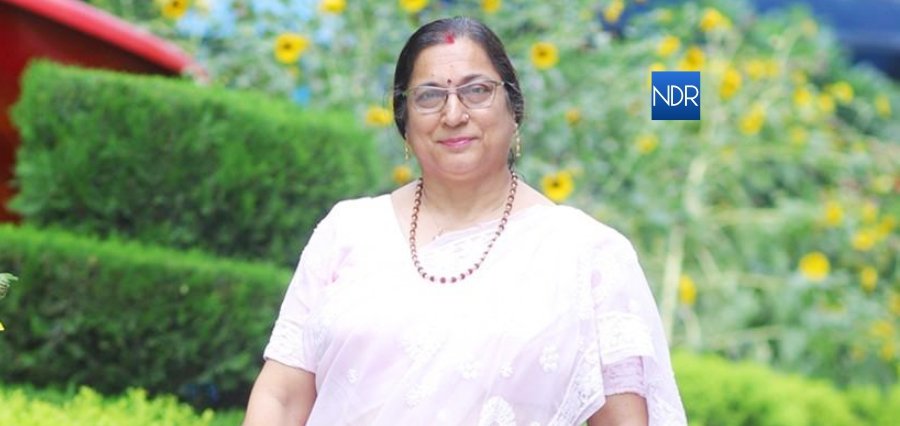
The education system exists from the beginning with its focus on grades and evaluation methods which Vibha Khanna demonstrates through her educational path because she chooses to study for learning purposes instead of getting good grades. Her path has been shaped not by conformity but by her constant belief that schools need to develop all students instead of creating only high achievers.
She has transformed conventional systems into active educational environments through her work with institutional frameworks while she spent years building new classroom teaching methods and dealing with resistance. Her leadership shows resilience and clear vision because she dedicates herself to complete student development which enables all students to become academically competent while developing their confidence and curiosity for future life experiences.
Reimagining the Purpose of Schooling
At the heart of Vibha’s work lies a single, disruptive idea that schools must stop functioning as exam factories and start operating as life-preparation ecosystems. She introduced this principle as a core institutional mandate, one that repositions sports, arts, leadership programs, Olympiad participation, and creative learning not as extracurricular afterthoughts, but as central pillars of education.
She did not make this shift quietly. Resistance was expected and it came. Many parents, teachers, and administrators had spent decades equating quality education with board results. Changing that mindset demanded persistence, patience, and proof. She delivered all three. Over time, her institutions created students who excelled academically while also earning recognition in cultural competitions, intellectual platforms, and sporting arenas. The data validated the vision: holistic development does not compromise academic performance rather it amplifies it.
Central to this transformation was her redefinition of the teacher’s role. Under her leadership, educators transitioned from information deliverers to mentors and facilitators. She invested heavily in continuous teacher development, turning classrooms into inquiry-driven, interactive spaces that ignite curiosity rather than suppress it. Simultaneously, she strengthened the school-parent-community triangle, building transparent communication channels and drawing parents into the learning process as partners rather than spectators.
Building the Architecture of Innovation
Vibha understands that vision without infrastructure remains an aspiration. This is why she built a structured innovative architecture resting on three interconnected pillars: technology integration, data-driven decision-making, and teacher empowerment.
She introduced digital learning platforms that will allow educators to monitor student progress in real time, identify knowledge gaps early, and design personalized learning interventions. Artificial intelligence and automation tools now assist in analyzing student performance, recommending targeted resources, and streamlining administrative functions enabling teachers to reclaim their time for what matters most: mentoring students. She also made future-readiness a subject, embedding coding, computational thinking, and digital literacy into the student experience as preparation for an AI-driven world.
Her innovation model, however, carefully preserves the irreplaceable human element. “Technology, in my opinion is an enabler never a substitute for the relationship between a student and a mentor. By fostering a culture of adaptability and continuous improvement, my institutions remain agile in the face of rapid educational change,” she says.
Cultivating a Culture That Embraces Disruption
Vibha’s leadership approach revolves around building institutional culture that starts with psychological safety. She focuses on creating an environment where teachers, administrators, and students feel genuinely free to voice unconventional ideas without fear of judgment or retribution. She actively models this openness, inviting dissent, listening without defensiveness, and publicly acknowledging when a colleague’s idea outperforms her own.
She reformed the organization’s relationship with failure of treating it not as a setback but as a learning mechanism. Performance systems in her institutions reward curiosity, initiative, and intelligent risk-taking. Structured forums for strategic dissent, including formal devil’s advocate processes in key decisions, ensure that critical perspectives receive a hearing before actions are finalized. This formalization of productive disagreement has become one of her most powerful leadership tools.
Khanna also champions diversity of thought as a competitive advantage. She builds cross-functional teams, encourages collaboration across departments, and hires intellectual curiosity as much as technical competence. “Decentralization of authority gives teams the autonomy to experiment, fail, learn, and innovate, while clear strategic direction keeps efforts aligned with institutional goals,” she says. The balance between freedom and focus is, in her view, the defining discipline of transformational leadership.
Navigating Uncertainty Without Losing Direction
Operating in volatile economic environments tests every leader’s resolve. Vibha face this challenge through what she calls integrated leadership. It is the deliberate fusion of bold long-term vision and disciplined short-term risk management. She breaks down ambitious goals into actionable milestones, uses scenario planning to prepare for multiple futures, and maintains financial prudence, including diversified revenue streams and operational reserves to protect institutional stability.
Real-time data and analytics inform her decisions, replacing reactive instinct with evidence-based strategy. Her emotional intelligence as a leader proves equally critical: in moments of organizational stress, she functions as a stabilizing force, acknowledging challenges transparently while projecting the calm confidence that keeps teams committed to the larger mission. For her, volatility is not an obstacle to vision. It is the very arena in which leadership is tested and proven.
The Legacy She Is Building
Looking five years ahead, Khanna envisions an education sector that has moved decisively beyond examination scores as its primary metric. She foresees personalized learning ecosystems powered by data and technology, where students follow individualized pathways and competency-based assessments track skills alongside knowledge. She expects to see measurable rises in student engagement, creativity, leadership participation, and social responsibility all as formal success indicators for institutions.
Her personal ambition is to build institutions that are not merely academically strong but deeply value-driven places where every child, regardless of background, discovers their potential and pursues excellence with confidence. The legacy she seeks is not measured in rankings or revenue, but in the quality of people her institutions send into the world: curious, resilient, compassionate, and capable of independent thought.